Lutathera Radiation Safety: Patient Instructions
As part of your treatment plan, you will be treated with Lutathera, a radioactive medication. This means that this type of medication uses radiation (X-ray energy). This radioactive medicine will slowly change to become non-radioactive. As this process happens, it releases radiation to damage and kill the cancer cells in your body. Because of this radiation, you will need to take steps to limit radiation exposure to the people around you.
Preventing Radiation Exposure to Others
The health risks of exposing your family members and the general public to radiation from your Lutathera treatment are low. However, you must still take steps to reduce exposure to those around you the day of treatment and for 2 days after. The best way to do this is by:
General Rules for Transportation
-
On your treatment day, when traveling by car with someone:
-
if you are driving, the other person should ride in the back seat.
-
if the other person is driving, you should ride in the back seat (this includes taxi cabs and other ride share cars).
-
If you traveled by plane to your treatment site, you need to wait at least 3 days after treatment to fly back home.
Contact with People in Your Household
On the day of treatment and 2 days after, you must avoid close contact with people who live with you. Try to keep a distance of at least 6 feet (2 meters or about 2 adult arm’s length).
The following are recommendations for contact with specific people in your household:
Contact with People at Work and Other Activities:
-
In general, you can return to work and other activities 3 days after treatment.
-
Speak with your provider if there are any specific reasons you will not be able to return to work.
Summary of Recommendations for Preventing Radiation Exposure to Others
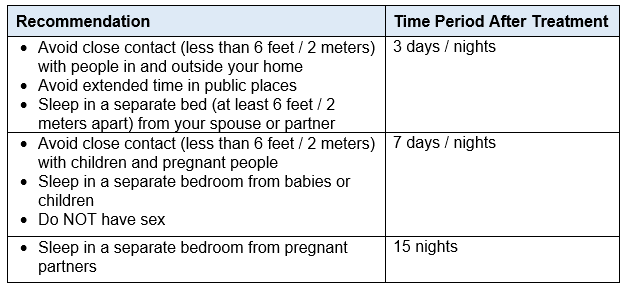
Special Care at Home
-
If you must stay in bed or have reduced movement, you will need help from a caregiver.
-
Caregivers must wear disposable gloves when helping you in the bathroom for 2-3 days after treatment.
-
Special medical equipment (catheters, colostomy bags, bedpan, water nozzle, or anything that could be contaminated by your body fluids) must be emptied into the toilet right away. Then the equipment must be cleaned.
-
If anyone helps you (or your caregiver) clean up vomit, blood, urine, or stool, they need to wear plastic gloves. Then, they should throw the gloves away in a plastic trash bag separate from all other household trash. (Follow the instructions under “Trash Handling and Disposal” below.)
General Rules for Bathroom Use and Hygiene
Using the Toilet
For the first 2 days after treatment:
-
You must use the toilet while sitting down. Do this even if you usually stand up to urinate.
-
You must wipe yourself with toilet paper each time you use the bathroom.
-
Flush toilet paper and wipes (if safe to flush) down the toilet .
-
Place items that cannot be flushed, such as menstrual or bladder leak pads and bandages, in separate plastic trash bags. (Follow the instructions under “Trash Handling and Disposal” below.)
-
Always wash your hands well after using the toilet. This keeps you from contaminating the bathroom door handles.
-
We strongly recommend that you have a bowel movement every day. Take a laxative (if needed) but you should have a daily bowel movement.
-
Drink plenty of fluids. This is so you can urinate (pee) often. Try to go every hour on your treatment day and for the next 2 days. (Follow your doctor’s advice on how much fluid to drink.)
Showers and Laundry
-
Shower every day for at least the first 7 days after treatment.
-
Wash your underwear, pajamas, sheets and any clothes that contain sweat, blood or urine separately from the laundry of other members of your household.
-
Wash these items 2 or 3 times using a standard washing machine.
Trash Handling and Disposal
-
Always keep your plastic trash bags separate and away from the other trash to reduce exposure to others.
-
Be sure to keep these bags away from children and animals.
-
A member of the care team will tell you how and when to get rid of these trash bags. You might be asked to bring the bag back to the site where you received your treatment. If you are not asked to bring the bags back, you can throw it away with other household waste 3 days after treatment.
Emergency Care and Hospital Stay
-
After your Lutathera treatment, your doctor may ask you to stay in the hospital. This is for further observation and for treatment, if needed.
-
Carry your discharge card with you at all times for at least 3 months after treatment. Small amounts of radiation from your body may trigger radiation monitors.
-
If for any reason you need emergency medical care during the first week after your treatment, tell the emergency medical providers about it. Tell them the type, date and the dose of your radioactive treatment.
-
If you have an unplanned hospital stay, you must let the providers know about your treatment.
Travel
-
You can start traveling 3 days after treatment.
-
Keep your discharge card with you whenever you travel for at least 3 months after your last treatment dose.
-
Small amounts of radiation from your body may trigger radiation monitors at different places. These include airports, border crossings, government buildings, hospitals, and waste disposal sites
Pregnancy and Breastfeeding Precautions
Pregnancy Precautions
-
You cannot start Lutathera treatment if you are pregnant. Lutathera can harm an unborn baby.
-
If you have missed a period, we cannot start treatment until you have a pregnancy test.
-
If you are pregnant, we will look at other treatments for you.
-
Because this medication is radioactive, people of childbearing age must use effective birth control methods.
-
If you are assigned female at birth, you should use a reliable method of birth control during treatment and for 7 months after your last dose.
-
If you are assigned male at birth with a partner who was assigned female at birth, they should use a reliable method of birth control during your treatment and for 4 months after your last dose.
Breastfeeding Precautions
-
Patients who are breastfeeding should stop. Lutathera can pass through the breast milk and cause harm to the baby.
-
Do not breastfeed during the treatment period and for 2 ½ months (10 weeks) after treatment.
-
Ask your doctor when you can start breastfeeding again.
©2024 NYU Langone Health. All rights reserved. Reviewed for health literacy. This information is not intended as a substitute for professional medical care. Always follow your health care provider's instructions.