Discharge Instructions after Gastric Band (Lap Band)
Care at Home After Surgery (Post-op)
Pain Management
-
When you go home, your pain medication plan may include both opioid and non-opioid medications.
-
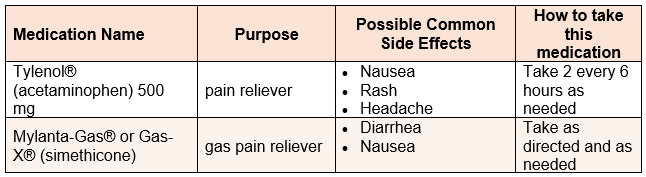
If you are using opioids for pain at home after surgery, you should be able to taper off of these medications after just a few days. The goal is to use only non-opioid pain medications such as acetaminophen (Tylenol®).
-
Left shoulder pain is common due to gas that was used during surgery. This gas pain should go away in 1-7 days after surgery. Walking should help relieve this pain. You can also try Mylanta-Gas® or Gas-X®.
Drains
Medications
-
Start taking all your regular medications when you get home.
-
All medications taken in the first 4 weeks after surgery must be crushed or in liquid form. For lap band patients, we recommend you continue this practice for life.
-
If you take any medications labeled as extended release, slow release, or long release, speak with your doctor about these medications to find an alternative. These types of medications cannot be crushed or opened.
-
Make sure to shake the bottle well before pouring for any liquid medications.
-
Open all your capsules (if they are not extended, slow or long release). Then mix the powder or beads with a small spoonful of unsweetened apple sauce or liquid. You may take liquid forms of your medicines if they are available.
-
Do not take non-steroidal anti-inflammatory (NSAIDs) medications for more than 3 consecutive days after surgery. Some examples of these medications are ibuprofen (Advil®, Motrin®, Bayer®, Excedrin®, naproxen (Aleve®), and celecoxib (Celebrex®). These can cause stomach discomfort, bleeding, or ulcers.
-
If another doctor prescribes any NSAID medications, please contact our team for guidance on appropriate alternatives or how to safely take them for a short time.
-
DO NOT start any birth control pills or use the NuvaRing® until 2 weeks after surgery.
-
If you are taking hormonal birth control, use an additional non-hormonal method (like condom or abstinence) for 30 days after surgery.
-
Important Reminder: While the lap band is in place, you may not have pills larger than a Tic-Tac® mint. Large pills will dissolve in your esophagus (above the Band), and not in your stomach where they should. The esophagus does not have a protective lining so the pills can cause ulcers. This can cause other complications including heartburn, acid reflux and stretching of the esophagus. Take pills with meals and never take a handful at a time. Try to avoid taking medications first thing in the morning and right before bedtime.
Medications You May Be Prescribed After Surgery
Your care team will prescribe you specific medications to take after your surgery. These medications are listed on the Discharge Medication list in your After Visit Summary (AVS). Do not take any prescription or over-the-counter medication unless your healthcare provider tells you to.

*Please note that if another provider prescribed omeprazole, esomeprazole, or a similar acid blocker, you can continue your medication as prescribed. We will not give you a new prescription if you were already taking this type of medication before surgery. If you need refills, please request it from your original prescriber.
Optional Over the Counter (OTC) Medications for Pain Relief
Hydration (Drinking Enough Fluids)
Hydration (drinking enough fluids) should be a top priority for all patients to prevent dehydration and constipation. Dehydration is one of the most common reasons for readmission to the hospital after weight loss surgery.
Below are some tips to help you avoid coming back to the Emergency Department after surgery:
-
Aim to drink 6-8 cups (48-64 ounces) of zero calorie, decaffeinated, and non-carbonated fluids per day.
-
Flavored water may be easier to drink than plain water after weight loss surgery. You can add a squeeze of lemon to water or try Crystal Light®, Propel Water®, or Vitamin Water Zero®.
-
Take small sips of water all day long. It may take one hour of frequent sipping to drink 8 ounces of fluid. It helps to set a timer for every 30 minutes to remind yourself to drink 3-4 ounces.
-
DO NOT gulp. Drink as if you were drinking hot tea. Do this to prevent stretching the stomach and prevent nausea and vomiting.
-
Avoid straws to prevent gas and discomfort.
-
Carry a water bottle with you at all times. But do not drink from the bottle because you can drink too quickly. Pour water into a cup and drink it from the cup.
-
Monitor your urine – darker colored urine may be a sign you are not drinking enough fluids. If you see your urine is dark, you need to drink more. Your urine should be light yellow.
-
Watch out for signs of dehydration including:
Important notes:
-
If you cannot drink at least 40 ounces (5 cups) of fluid each day for 2 days in a row, please CALL our office right away.
-
Do not email or send a message through MyChart.
-
You may need to have fluids given to you through an IV, either at our office, at an infusion center or at home.
|
Constipation
-
Anesthesia and opioids will slow down your digestive tract after surgery. This can cause constipation. You can ease this by drinking more fluids and walking more.
-
It is normal to move your bowels less often after weight loss surgery. Sometimes every other day or every 2 days is normal.
-
If your constipation does not go away within the first week, contact our office.
-
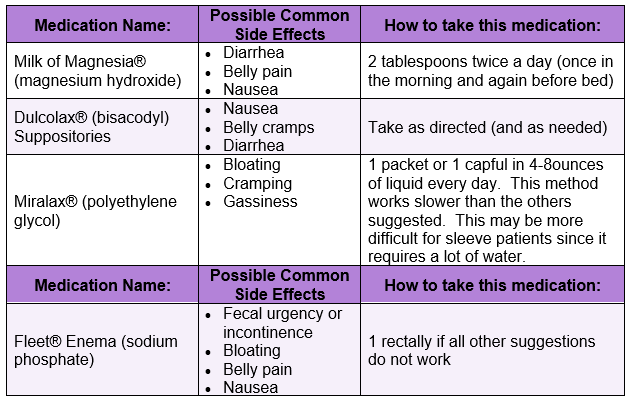
If you do not have a bowel movement (stool) by day 3 after surgery and you are uncomfortable, we recommend taking one of the following OTC medications (generic versions are okay to take):
Diarrhea
-
You may have diarrhea (loose stools) for several days after surgery. This is a side effect of the protein shakes. Your bowel movements should return to normal when you begin the pureed diet stage. You can take OTC Pepto Bismol® or Imodium®.
-
If diarrhea continues one week after discharge, contact our office.
Care of Your Incisions (Cuts)
-
Your incisions will be covered with a Tegaderm™ dressing. This is a clear, plastic, waterproof material.
-
You can take showers with these dressings on. However, tub baths, hot tubs, or swimming are NOT allowed for 4 weeks after surgery.
-
Please remove the Tegaderm™ 3 days after surgery and allow the paper steri-strips to fall off on their own. Do this unless advised differently by our team.
-
If surgical staples or stitches were used to close your incisions, you will need an in-person post-op check in our office 7-10 days after your surgery. The staples or stitches will be removed during this visit.
-
You can expect some pain, bruising, and clear or sometimes bloody drainage at the incision sites. If there is blood oozing in small amounts, hold direct pressure on the area for a full 5 minutes. The bleeding should stop. It is ok to reinforce the incision with a Band-Aid or dry gauze.
-
Call our office right away at 212-263-3166 if you have any of the following signs of infection:
-
The incisions become red, more painful or swollen, hot to the touch
-
Cloudy or foul-smelling drainage
Physical Activity and Rest
-
Your recovery will take several weeks. This depends on your age and your general health. Feelings of fatigue (being tired) are normal. For this reason, you should try to rest as needed.
-
We strongly recommend you continue to walk as often as tolerated. This prevents blood clots, lung infections, gas pain, and constipation.
-
Do not overdo it. Increase your activity level slowly.
-
You will get tired more easily for a while after surgery. This is normal. Your periods of activity will gradually get longer before you need to rest.
-
You can start walking on a treadmill 1 week after discharge. However, no weight lifting or abdominal sit-ups for 4 weeks.
-
Avoid lifting, pushing, and/or pulling anything heavier than 10 pounds for 4 weeks after surgery. For example, a gallon of milk is about 8 pounds.
-
You can climb stairs. However, we recommend that you climb them slowly at first. Pause after every few steps.
-
Continue to use your incentive spirometer at home. Also continue the coughing and deep breathing exercises you were taught. Do this until your first post-op appointment.
-
Do not drive for 1 week after discharge (until you are off prescribed pain medication). Opioid/prescription pain medication can make you drowsy and slow to react when driving.
-
You can resume sexual activity 2 weeks after discharge.
Returning to Work
Follow-Up Care and Visits
-
It is very important that you stay in touch with our team on a regular basis. This way we can monitor (check) your progress and weight loss.
-
Your first post-op appointment with your surgeon or one of our clinicians should be 7-10 days after surgery. Your second post-op appointment should be 1 month after your first post-op visit.
-
You should see your PCP (primary care provider) within 1-2 weeks after surgery to adjust any other medications you took before your surgery. This includes medications such as those for high blood pressure, cholesterol, and diabetes.
-
We also strongly recommend that you regularly follow up with our Registered Dieticians (RD) as well.
-
If your first post-op visit has not already been scheduled, schedule it by calling our office directly at 212-263-3166. You can also schedule your appointment through MyChart.
-
Esophagrams:
-
You will need an esophagram (a special type of x-ray) after your discharge. This procedure involves swallowing a liquid before the x-ray. This liquid will outline your esophagus so that it can be seen on the x-ray.
-
You need to have this x-ray done every year at the NYU Langone Radiology Department.
-
To schedule your first esophagram appointment, call the Radiology Department directly at 212-263-8868. Please try to schedule this esophagram on the same day as your first post-op appointment. If this is not possible, schedule the esophagram sometime BEFORE your post-op visit.
-
If you are not able to schedule your own esophagram or have any difficulties, call our office at 212-263-3166.
Diet Progression After Your Surgery
As you go through the different diet stages after your surgery, remember:
-
Each person is different.
-
Listen to your body!
-
Do NOT advance to the next stage of your diet before the suggested time.
-
Only advance when you are comfortable. Each stage of the diet can be made longer, but not shorter.
-
Refer to the Nutrition Guidelines in Your Bariatric Surgery Journey Guide for full guidance.
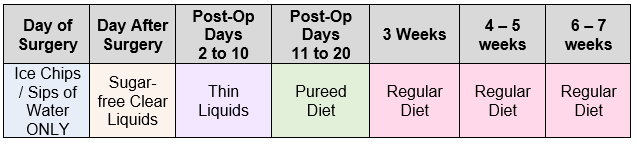
The stages of your diet are:
Thin Liquids
Advance from sugar-free clear liquids to the thin liquids diet below. Try to have at least 4 ounces of fluids every hour and increase to 8 ounces of fluid per hour as tolerated.
-
Drink plenty of fluids to prevent dehydration and constipation. Aim for 6-8, eight-ounce glasses (48-64 ounces total) of fluid daily (not including your protein shakes).
-
Sip your fluids slowly all day long. Do not gulp. Drink as if you were drinking hot tea. This will prevent your stomach from stretching and prevent nausea and vomiting. It may take you one hour of constant sipping to drink 8 ounces of fluid.
-
Remember that fluids should be thin enough so that you could sip them through a straw. However, do not actually drink any liquids with a straw because this can cause you gas and discomfort.
-
Avoid carbonated drinks. These can cause gas and discomfort.
-
For the first week, we recommend diluting, or thinning, protein shakes with water or skim milk. This way you avoid the risk of vomiting or pain.
-
Your protein goal to work towards is 60 or more grams of protein.
Pureed Food Diet
-
In this stage, try to increase to 4-6 ounces of fluid every hour while adding in pureed foods.
-
Avoid drinking with meals from this point on. The reason is that this can increase your chances of vomiting.
-
Do not drink for 5 minutes before and 20 minutes after meals.
-
Get into the habit of eating protein first. Your goal should be 60 grams of protein daily.
-
Do not eat eggs until 4 weeks after surgery. Eggs are difficult to digest when your stomach size has been reduced.
-
Eat a balanced healthy diet with a focus on protein and nutrient rich foods.
-
To puree food:
-
Cut food into small pieces no bigger than a pencil eraser and then cook.
-
Keep the fluid that the food was cooked in and set it aside.
-
Blend the food in a blender or food processor, adding the kept liquid/juice until it has the consistency of applesauce.
-
Strain any lumps or pieces.
-
Final consistency should be smooth.
-
Use spices to flavor your pureed food.
-
Continue to have protein shakes as a meal replacement.
-
Blend soups for a quick and easy meal. Make sure to strain any lumps or pieces that did not blend. And add broth to thin out soups that are too thick. You can add unflavored protein powder to meet your dietary needs.
-
Examples of low-fat, low sugar or sugar-free pureed foods include:
-
Blended tuna fish with light mayonnaise, blended dark meat chicken
-
Pureed vegetables
-
Pureed soups, low-fat creamy soups – no chunks
-
Yogurt (no fruit pieces and no sugar added)
-
Ricotta cheese, small curd cottage cheese
-
Baby food fruits and vegetables (choose low sugar, higher protein)
-
Cream of Wheat® or Farina®, runny oatmeal
-
Silken tofu, non-fat refried beans (smooth), hummus
-
Fruit sauces – No sugar added (apple, pear)
Important Dietary Tips
-
A long-term goal is to eat only 2-3 meals a day. Start this habit while on your pureed diet. Eat only when you are hungry. Avoid snacking as this will slow down weight loss.
-
Note: You can stop taking the protein shakes once you have started your pureed diet. However, if you wish to replace a meal (for example, breakfast) with a shake, you may do so.
-
If you are hungrier in the first 2 weeks, drink more protein-rich drinks (for example, protein shakes, milk). Do not advance your diet too quickly as you will increase your chances of vomiting. Remember that you are on a liquid diet to help promote healing.
-
Stop eating when you feel full to avoid vomiting. Vomiting may cause band slippage. Your “pouch” or smaller stomach can only hold about ½ a cup to 1 cup of food per meal. If you overeat, you may also become nauseous or have pain. Learn to listen to your body.
-
Eat food in the following order. Your meals should include protein first, then fruits and vegetables. Then have whole grains.
-
Eat protein rich foods. Protein rich foods usually come from animal products (chicken, fish, eggs, cheese, yogurt, etc.). However, do not eat eggs until 4 weeks after surgery. Beans, nuts (peanut butter) and tofu are also great sources of protein. Protein will help preserve lean muscle and help promote wound healing.
-
Limit fats as they can cause nausea and weight gain.
-
Eat slowly. It should take you 30 minutes to eat each meal! You do not have to finish all the food on your plate.
-
Chew slowly and thoroughly – Try cutting up food into small pieces.
-
Remember your stomach can only hold a few tablespoons right after surgery. Eventually, it can hold about ½ to 1 cup per meal. (After 6 months, a ½ sandwich can be a meal. After one year, a Lean Cuisine® sized entrée can be a meal.)
-
To prevent food intolerances, introduce new foods one at a time to help rule out the source of the intolerance. If you cannot tolerate a food, take it out of your diet and then reintroduce in after one week. If dairy seems to be an issue, substitute Lactaid for milk, or you can take lactase pills with dairy to help digest the lactose.
-
Fluids: Drink at least 6-8 cups (48-64 ounces) of fluid per day. We highly recommend this, so you do not get dehydrated and constipated. We also recommend that you carry a water bottle around with you. This will help you stay hydrated.
|
When to Call Your Healthcare Provider
CALL our office at 212-263-3166 if you have any of the following signs and symptoms:
-
Signs of infection at your incision(s):
-
Increased pain, swelling, redness, or heat
-
Cloudy or foul-smelling drainage
-
Signs of a bladder or urinary tract infection (UTI):
-
Burning, pain, bleeding, hesitancy, frequency when urinating
-
Fever higher than 100.8° F (38.2° C) on 2 or more times during the first 1-3 weeks after surgery. For a reliable temperature reading, do not take aspirin, acetaminophen (Tylenol®) or ibuprofen for 3-4 hours before. Do not have hot liquids right before taking your temperature.
-
A fast heart rate - usually greater than 120 beats per minute. To calculate this, place your index finger over your pulse on the inside of your wrist nearest your thumb. Then count the number of beats for 15 seconds. Multiply this number by 4.
-
If you cannot drink at least 40 ounces (5 cups) of fluid each day for 2 days in a row.
-
Shaking chills (rigors) or night sweats
-
Persistent pain, nausea, and/or vomiting after eating
-
Persistent diarrhea after the first week of being discharged
-
New onset of upper back, chest, or left shoulder pain. You may have lower back pain. This is normal.
-
Persistent hiccups and abdominal (belly) pain for more than 2 hours
-
Fatigue (lengthy or not usual)
-
Disorientation or confusion
-
Depression
-
Trouble breathing or shortness of breath
-
Swollen or painful leg
Please do NOT use MyChart for any urgent or developing medical issues.
MyChart is ONLY for non-urgent questions.
|
Post Bariatric Support Groups
NYU Langone has Post Bariatric Surgery Support Groups that meet monthly via Webex. They meet every 2nd and 4th Wednesday from 6:00pm to 7:30pm.
For more information and for group details, email: [email protected]
© 2025 NYU Langone Health. All rights reserved. Reviewed for health literacy. This information is not intended as a substitute for professional medical care. Always follow your health care provider's instructions.